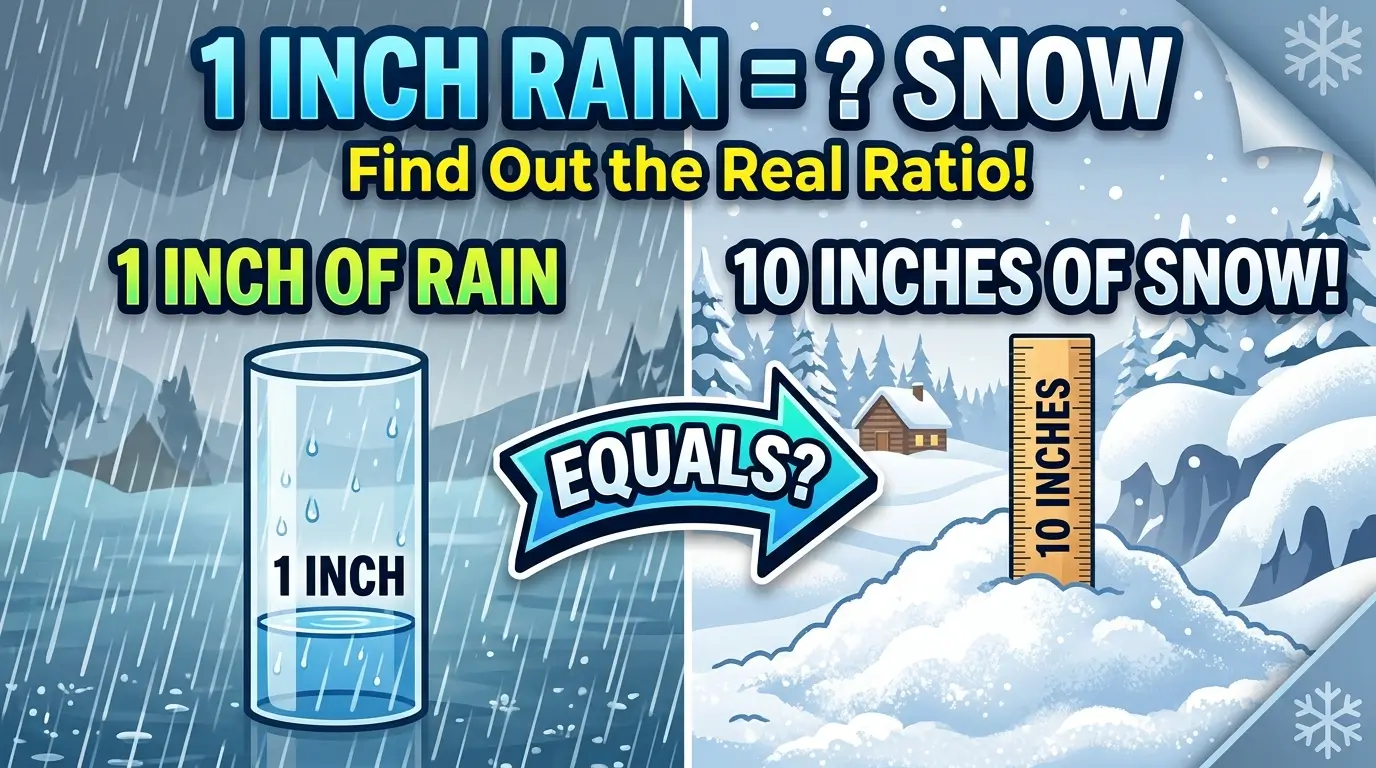
1 Inch of Rain Equals How Much Snow? Rain to Snow Conversion Guide
Have you ever looked outside during a winter storm and wondered — if this were rain instead of snow, how much liquid would that actually be? Or maybe your weather app is showing 0.5 inches of precipitation and you want to know: will that mean 5 inches of snow or 20?
You are not alone. This is one of the most searched winter weather questions in the United States — and the answer is more interesting than most people expect.
Let’s break it all down.
1 Inch of Rain Equals How Much Snow?
According to the National Oceanic and Atmospheric Administration (NOAA), on average 1 inch of rain equals 13 inches of snow in the United States. However, this number is not fixed. Depending on temperature and snow density, that same 1 inch of rain can produce anywhere from 2 inches of heavy sleet-like snow all the way up to 50 inches of ultra-dry powder snow under extreme cold conditions.
The most commonly used ratios are:
- 10:1 — The old standard rule of thumb (still widely used)
- 12:1 — The updated average preferred by many forecasters today
- 13:1 — NOAA’s official national average for the US
So when someone asks how much snow is 1 inch of rain, the honest answer is: it depends on the temperature. But 13 inches is your best starting point.
Why Does Rain Turn Into So Much Snow?
This surprises a lot of people. One inch of rain becoming 13 inches of snow sounds like a lot — but it makes perfect sense once you understand snow’s structure.
Snow is not solid water. A snowflake is mostly air trapped between ice crystals. Think of it like a very loose, fluffy sponge. When that sponge melts, it becomes a tiny fraction of its original volume.
The colder the temperature, the more air gets trapped inside snowflakes, making them lighter and fluffier. That is why a blizzard at 10°F produces much deeper snow than a storm at 31°F dropping the same amount of moisture.
This is the core science behind every rain to snow conversion formula meteorologists use.
Rain to Snow Conversion by Temperature: The Complete Chart
This is where most articles fall short — they give you one number and call it a day. But professional forecasters use a temperature-based conversion table because the ratio changes dramatically depending on how cold it is.
Here is the full rain to snow conversion chart based on data from the National Weather Service (NWS) and Sciencing:
| Temperature (°F) | Snow Ratio | 1 Inch of Rain = |
|---|---|---|
| 28°F – 34°F | 10:1 | 10 inches of snow |
| 20°F – 27°F | 15:1 | 15 inches of snow |
| 15°F – 19°F | 20:1 | 20 inches of snow |
| 10°F – 14°F | 30:1 | 30 inches of snow |
| 0°F – 9°F | 40:1 | 40 inches of snow |
| -1°F to -20°F | 50:1 | 50 inches of snow |
| -21°F to -40°F | 100:1 | 100 inches of snow |
Yes, you read that right. At extreme temperatures below -20°F, 1 inch of rain can theoretically produce 50 to 100 inches of snow. However, at those temperatures the atmosphere holds so little moisture that such large accumulations are extremely rare in practice.
For everyday winter storms in most of the US, you will be working with ratios between 10:1 and 20:1.
How Many Inches of Snow Is 1 Inch of Rain? (By Snow Type)
Another way to look at the rain to snow equivalent is by snow type rather than temperature alone. Different types of snowfall have different densities:
Wet, Heavy Snow (Near Freezing, 28°F–34°F)
- Rain to snow ratio: 5:1 to 10:1
- 1 inch of rain = 5 to 10 inches of snow
- This is the heavy, packing snow great for snowballs and snowmen
- Wet snow typically has a ratio of about 5–8:1 according to meteorologists
- Common in coastal areas, the Pacific Northwest, Nashville, and Raleigh
Average Snow (Standard Conditions, 20°F–28°F)
- Rain to snow ratio: 10:1 to 15:1
- 1 inch of rain = 10 to 15 inches of snow
- The most common type used in weather forecasts
- What most people picture as “normal” snowfall
Light, Fluffy Powder Snow (Cold and Dry, Below 20°F)
- Rain to snow ratio: 20:1 to 50:1
- 1 inch of rain = 20 to 50 inches of snow
- Common in the Rockies, Upper Midwest, and interior mountain ranges
- Famous ski resort snow — light, dry, and deep
Sleet and Freezing Rain (Right at Freezing)
- Rain to snow ratio: 2:1 to 4:1
- 1 inch of rain = only 2 to 4 inches of sleet
- Very dense, icy, and dangerous on roads
Rain to Snow Conversion Formula
If you want to convert rain to snow yourself, the formula is simple:
Inches of Snow = Inches of Rain × Snow Ratio
And to go the other direction — snowfall to rain conversion:
Inches of Rain = Inches of Snow ÷ Snow Ratio
Example 1: Standard Storm at 25°F
- Forecast: 0.75 inches of rain equivalent precipitation
- Temperature: 25°F → Snow ratio = 15:1
- Calculation: 0.75 × 15 = 11.25 inches of snow
Example 2: Cold Polar Storm at 12°F
- Forecast: 0.5 inches of rain equivalent
- Temperature: 12°F → Snow ratio = 30:1
- Calculation: 0.5 × 30 = 15 inches of snow
Example 3: Wet Coastal Storm at 31°F
- Forecast: 1 inch of rain equivalent
- Temperature: 31°F → Snow ratio = 10:1
- Calculation: 1 × 10 = 10 inches of snow
This is exactly how meteorologists use precipitation to snow conversion when building their forecasts.
Rain to Snow Calculator: Quick Reference Table
Use this handy rain to snow calculator reference to look up your answer instantly:
| Rain Amount | At 10:1 (Wet Snow) | At 13:1 (Average) | At 20:1 (Powder) |
|---|---|---|---|
| 0.1 inch | 1 inch of snow | 1.3 inches | 2 inches |
| 0.25 inch | 2.5 inches | 3.25 inches | 5 inches |
| 0.5 inch | 5 inches | 6.5 inches | 10 inches |
| 1 inch of rain | 10 inches | 13 inches | 20 inches |
| 1.5 inches | 15 inches | 19.5 inches | 30 inches |
| 2 inches of rain | 20 inches | 26 inches | 40 inches |
| 3 inches | 30 inches | 39 inches | 60 inches |
How Much Snow Equals 1 Inch of Rain? — By US Region
Geography plays a big role in how many inches of snow equals an inch of rain. A university professor of meteorology at Central Michigan University created a map showing average snow ratios across the country. Here is what the data shows:
Upper Midwest (Minnesota, Wisconsin, the Dakotas): Average snow ratio of 13:1 to 14:1. Cold, dry winters mean fluffier snow. 1 inch of rain typically produces 13 to 14 inches of snow.
Great Lakes Region (Lake Effect Snow Areas — Western New York, Michigan): Average ratio of 15:1 to 16:1. Lake effect snow is famously light and deep. These areas regularly see ratios higher than the national average.
Rocky Mountain States (Colorado, Utah, Wyoming): Some of the highest ratios in the country — often 15:1 to 20:1 or more. This is why Colorado is famous for its deep powder. Ski resorts in this region often market their “champagne powder.”
Pacific Northwest (Seattle, Portland): Some of the lowest ratios — around 9:1 to 10:1. Snow here is wet and heavy because temperatures rarely drop far below freezing.
Southeast and Mid-South (Nashville, Raleigh, Atlanta): Also low ratios — 9:1 to 10:1. Snow in these areas is usually a wet, marginal event right near the freezing point.
Northeast (New York, Boston, Philadelphia): Variable — typically 10:1 to 13:1 depending on the storm. Coastal nor’easters can bring wet, heavy snow while inland Arctic outbreaks produce lighter powder.
One Inch of Snow: What Does It Actually Mean in Real Life?
Many people also search the reverse — not how many inches of snow is 1 inch of rain, but rather how much is 1 inch of snow on its own.
Here is what one inch of snow means in practical terms:
- Roads: Light coating. Mostly passable but can be slippery, especially on bridges and overpasses.
- Driving: Caution recommended. Black ice is a bigger threat than the snow itself.
- School closings: Rarely triggers closures on its own, though in southern states where snow is uncommon, even 1 inch can cause closures.
- Shoveling: A light pass with a shovel or broom. Takes about 5 to 10 minutes for an average driveway.
- Water content: About 0.07 to 0.10 inches of liquid water equivalent.
How Much Is 2 Inches of Snow vs. 10 Inches of Snow?
People often ask how much is 2 inches of snow or is 10 inches of snow a lot? Here is a practical breakdown:
| Snowfall Amount | What to Expect |
|---|---|
| 1 inch | Light dusting, roads slippery, usually no closures |
| 2 inches | Noticeable accumulation, shoveling needed, some delays |
| 3 to 4 inches | Moderate storm, school closures likely in many areas |
| 6 inches | Significant snowfall, plowing required, widespread delays |
| 10 inches | Major snowstorm — yes, 10 inches of snow is a lot for most cities |
| 18 to 24 inches | Blizzard-level accumulation, travel bans, state of emergency possible |
Is 10 inches of snow a lot? Absolutely. For most American cities, 10 inches is a significant, memorable snowstorm that causes widespread school and business closures and requires major plowing efforts. Only cities in the snowiest parts of the country — like Buffalo, Syracuse, or Denver — treat 10 inches as a manageable event.
Real World Example: The December 2009 Philadelphia Snowstorm
NBC10 Philadelphia reported on this exact topic using a real storm. During a major December 2009 snowstorm, temperatures were around 25°F — colder than a typical storm.
The storm dropped 1.75 inches of liquid equivalent precipitation. Using the old 10:1 rule, you would expect about 17.5 inches of snow. But because of the colder temperatures and higher snow ratio (closer to 15:1), the region ended up with 23.2 inches of snow — significantly more than the simple formula suggested.
This is a perfect real-world example of why temperature-adjusted rain to snow conversion matters so much for accurate forecasting.
Snowfall to Rain Conversion: Going in Reverse
Sometimes you want to go the other direction. Maybe you measured snow on the ground and want to know the rain equivalent. Here is the snowfall to rain conversion:
Rain = Snow ÷ Snow Ratio
| Snow Amount | Rain Equivalent (10:1) | Rain Equivalent (13:1) |
|---|---|---|
| 5 inches of snow | 0.5 inches of rain | 0.38 inches |
| 10 inches of snow | 1 inch of rain | 0.77 inches |
| 13 inches of snow | 1.3 inches of rain | 1 inch |
| 20 inches of snow | 2 inches of rain | 1.54 inches |
| 30 inches of snow | 3 inches of rain | 2.3 inches |
This precipitation to snow conversion in reverse is especially useful for water resource managers, farmers, and flood risk analysts who need to know how much water will enter streams and rivers when spring snowmelt begins.
How Much Rain Equals Snow?
Snow forms when water vapor in clouds freezes directly into ice crystals at temperatures at or below 32°F (0°C). These crystals stick together to form snowflakes, and as they fall, they collect more moisture from the air around them.
The key scientific principle is this: snow is mostly empty space. A snowflake’s branching structure traps huge amounts of air between the ice. The colder it is, the more branching occurs and the more air gets trapped — which is why cold powder snow is so much lighter and fluffier than warm, wet snow.
This is also why how much rain is equivalent to snow varies so dramatically. You are essentially measuring how much air is mixed into the precipitation.
Frequently Asked Questions
Q: How many inches of snow is 1 inch of rain? A: On average, 13 inches of snow per NOAA’s national average. Can range from 10 inches (wet snow near freezing) to 20+ inches (cold powder snow below 20°F).
Q: How many inches of rain equals snow for school closings? A: Schools look at total snowfall accumulation, not rain equivalent. Generally 4 or more inches of snow triggers closures in most US districts, though this varies widely by region.
Q: One inch of rain equals how many inches of snow at 25°F? A: At 25°F, the snow ratio is approximately 15:1. So 1 inch of rain would produce about 15 inches of snow.
Q: How much rain equals snow if it is raining and snowing at the same time? A: Mixed precipitation makes this tricky. Meteorologists separate the rain and snow portions and calculate each separately, then add them up.
Q: How many inches of rain to snow if I want to know how deep my yard will be? A: Use the 13:1 average as your starting point. Check your local temperature and adjust using the chart above for a more accurate estimate.
Q: Is there an easy way to convert rain to snow? A: Yes — multiply your rain total by 10 for a quick conservative estimate. For more accuracy, use the temperature-based chart in this article.
Q: How much is one inch of snow worth in water? A: About 0.07 to 0.10 inches of liquid water on average.
Will There Be a Snow Day Tomorrow?
Now that you know how much snow 1 inch of rain can produce, you can better judge whether your area is heading for a major snow event. But knowing the snowfall amount is just one piece of the puzzle.
School closures also depend on road conditions, when snow falls (overnight vs. morning), local resources for plowing, and the policies of your specific school district.
That is where our Snow Day Calculator comes in. Enter your location and get an instant, data-backed prediction on whether school will be canceled tomorrow — powered by real weather data and smart algorithms.