How Accurate Is a Snow Day Calculator? What Parents and Students Should Really Expect
It’s 9 PM, snow is in the forecast, and half the internet is refreshing a snow day calculator hoping for a magic number that guarantees a day off. If you’ve ever typed “will school be cancelled tomorrow” into Google at midnight, you already know the feeling. But how much can you actually trust that percentage on the screen?
The short answer: snow day calculators are surprisingly science-based, not just a random number generator, but they’re also not fortune tellers. Most land somewhere between 70% and 90% accurate, and that range depends heavily on where you live, how the storm behaves, and how your specific school district makes decisions. Let’s break down why.
What Exactly Is a Snow Day Calculator?
A snow day calculator (sometimes called a snow day predictor or school closing predictor) is an online tool that estimates the probability schools will close due to winter weather. You type in your ZIP code or city, and within seconds it spits out a percentage between 0% and 100%.
Behind that simple number is a mix of real weather data and pattern recognition. The tool isn’t guessing snowfall out of thin air — most legitimate calculators pull from National Weather Service data, local forecast models, and historical closure records for your area. Some, like the popular Snow Day Calculator site, claim to process data for millions of ZIP codes across the U.S. every winter.
The idea is simple: combine “how bad is the storm” with “how has this school district responded to storms like this before” and turn that into a single, easy-to-read number.
The Data Behind the Prediction
If you’re wondering how a snow day calculator works under the hood, it typically weighs several inputs together:
- Snowfall totals – how many inches are expected, and over what time window
- Storm timing – snow falling overnight gives plows time to clear roads; snow falling during the morning commute is far more disruptive
- Temperature and wind chill – extreme cold alone can shut schools down even without snow
- Ice accumulation – freezing rain is often more dangerous than snow, and many districts close for ice before they’d ever close for a few inches of snow
- Road and travel conditions – rural districts with long bus routes tend to react differently than compact urban districts
- Historical closure patterns – if a district closed for similar conditions in past years, that history gets factored into the new prediction
Some newer tools also describe using machine learning models that “learn” from previous seasons, adjusting future predictions based on whether past forecasts turned out to be right or wrong.
So, How Accurate Are Snow Day Calculators?
Here’s where it gets nuanced. Most calculators report accuracy somewhere in the 70–90% range, and a few claim even higher numbers — up to 95–98% — under ideal conditions, like when a major blizzard is clearly on the way.
That accuracy isn’t fixed, though. It moves depending on the size of the storm:
- Light snow (2–4 inches): Accuracy tends to drop to around 60–70%, because this is exactly the gray zone where some districts close and others don’t.
- Moderate snowfall (5–8 inches): Predictions get noticeably more reliable, often in the 80–85% range.
- Heavy snow or blizzard conditions (10+ inches): This is where calculators shine, frequently hitting 95%+ accuracy, because almost every district closes regardless of policy differences.
In other words, a snow day calculator is at its best when the answer is already fairly obvious, and at its shakiest during borderline storms — which, ironically, is exactly when people check it most obsessively.
Why Predictions Sometimes Get It Wrong
Even the best snow day calculator is working with the same core problem meteorologists face: weather is chaotic, and small changes can flip an outcome entirely.
A few common reasons predictions miss the mark:
The storm shifts at the last minute. A system that looked set to dump six inches can weaken, change direction, or arrive a few hours later than expected — enough to change a school’s decision entirely.
Rain instead of snow. One of the most common failure points: temperatures rise slightly overnight, precipitation that was supposed to be snow falls as rain, and a calculator showing an 80% chance of closure ends up wrong because schools stayed open.
District policy isn’t uniform. This is arguably the biggest limitation. A calculator can measure snowfall precisely, but it can’t fully capture how conservative or lenient a specific superintendent tends to be. Some districts close at the first sign of 3–4 inches; others push through 8–10 inches without blinking, especially in northern states where snow removal infrastructure is stronger.
Human judgment isn’t in the model. At the end of the day, a real person — usually a superintendent working with transportation and safety teams — makes the final call at dawn, checking actual road conditions, icy hills, and bus routes that no algorithm has visibility into. A calculator is a smart estimate; it isn’t the decision-maker.
Regional Differences Matter More Than People Realize
A snow day calculator doesn’t apply the same standard everywhere, and that’s actually a good thing. Snow tolerance varies dramatically by region:
- Northern and snow-belt states (parts of the Midwest, New England, upstate New York) are used to snow. Four to six inches often isn’t enough to trigger a closure unless the timing is bad or ice is involved.
- Mid-sensitivity regions may close schools for 4–8 inches, especially if it falls during rush hour.
- Southern and warm-climate states have far less snow infrastructure. Even 1–2 inches of snow or a light coating of ice can shut schools down completely, simply because roads aren’t treated the same way and drivers aren’t used to icy conditions.
- Rural, hilly, or mountainous districts often close for smaller accumulations than flat urban areas, because winding roads and long bus routes become hazardous quickly.
This is why two towns 50 miles apart can see identical snowfall totals and get completely different outcomes — and why a good calculator adjusts its prediction based on ZIP code rather than giving everyone the same generic number.
Snow Day Calculator vs. Weather Forecast vs. Official School Announcement
It’s worth being clear about what each of these actually tells you:
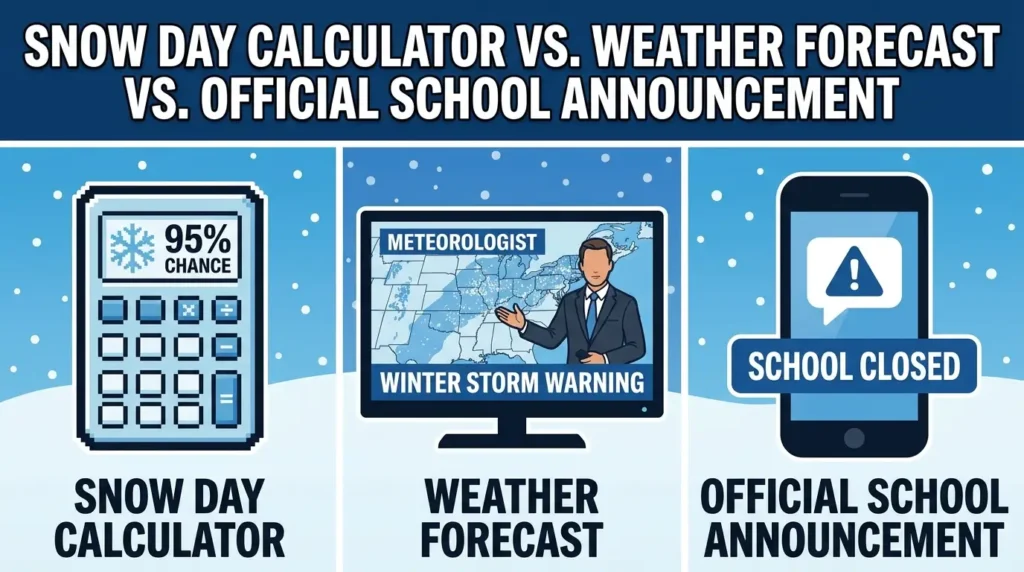
- A weather forecast tells you what the atmosphere is expected to do (snowfall, temperature, wind).
- A snow day calculator takes that forecast and layers your district’s historical closure behavior on top of it, translating raw weather into a closure probability.
- The official school announcement is the only source that actually decides anything. It accounts for real-time road conditions, staffing, and safety assessments that no online tool can see in advance.
Think of the calculator as a well-informed guess, not a replacement for checking your district’s website, app, or local news in the morning.
How to Get the Most Reliable Prediction
If you want to squeeze the best possible accuracy out of a snow day calculator, timing your check matters:

- Check the evening before, once forecast models have had time to converge on a more confident storm track.
- Check again early morning, right before the decision window — this is usually when predictions are most refined, since overnight snowfall and road treatment have already happened.
- Don’t rely on a single check. If your ZIP code shows 65% at 7 PM and jumps to 85% by 6 AM, that’s normal — the storm’s actual behavior is simply becoming clearer.
- Always confirm with your school district directly before making plans, especially for a borderline percentage anywhere between 40–70%.
The Bottom Line
Snow day calculators aren’t gimmicks. They’re built on genuine meteorological data — snowfall, timing, temperature, ice risk — combined with historical patterns of how your specific school district behaves during winter weather. Used correctly, they land in the 70–90% accuracy range, and can climb even higher during major storms.
But they’re a planning tool, not a promise. Weather can shift overnight, and the final decision always rests with real people weighing road safety, not a percentage on a screen. Check the calculator to plan your evening, check your district’s official channel to confirm your morning, and you’ll get the best of both.
Frequently Asked Questions
Generally yes, within a 70–90% range for most storms, with higher accuracy during major snow events and lower accuracy during light or borderline snowfall.
No. It only estimates probability based on weather and historical data. The actual decision belongs to school administrators.
Usually because the storm changed — snow turned to rain, temperatures rose, or the district simply has a higher tolerance for snow than the algorithm assumed.
The night before for early planning, and again early morning for the most refined, storm-adjusted prediction.
No. Predictions are adjusted by region, since southern states typically close for far less snow than northern, snow-prepared states.
Conclusion:
At the end of the day, a snow day calculator is exactly what its name suggests: a calculator, not a crystal ball. It’s not pulling numbers out of thin air — it’s genuinely built on meteorological data, ZIP-code-level forecasting, and years of historical closure patterns from real school districts. That’s why, for most storms, it lands in a respectable 70–90% accuracy range, and can climb well above 90% when a major storm makes the outcome almost obvious.
Where it struggles is exactly where you’d expect any prediction tool to struggle: the gray-zone storms. A few inches here, a slight temperature swing there, or a district with an unusually cautious (or unusually stubborn) closure policy can all tip a “likely closure” into a normal school day, or vice versa. That’s not the calculator failing you — it’s a reminder that weather is genuinely unpredictable, and that the final call always rests with people, not percentages.
The smartest way to use a snow day calculator, then, isn’t to treat its number as gospel. Check it the night before to plan ahead, check it again in the early morning once the storm has actually played out, and always confirm with your school district’s official announcement before you make firm plans. Do that, and you’ll get the best of both worlds: the convenience of an early heads-up, and the certainty of an official decision when it matters most.
Read More:
- How Accurate Is a Snow Day Calculator? What Parents and Students Should Really Expect
- 1 Inch of Rain Equals How Much Snow? Rain to Snow Conversion Guide